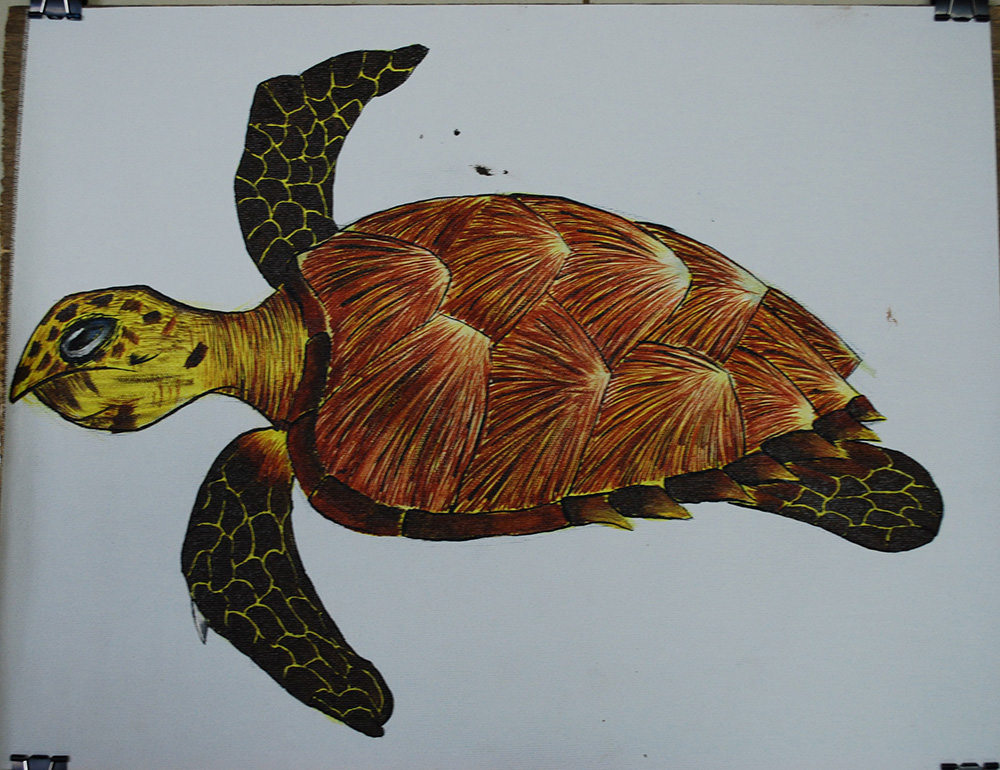
Eretmochelys imbricata (Linnaeus, 1757)
Animalia (Kingdom) > Chordata (Phylum) > Vertebrata (Subphylum) > Gnathostomata (Infraphylum) > Tetrapoda (Megaclass) > Reptilia (Superclass) > Testudines (Order) > Cryptodira (Suborder) > Chelonioidea (Superfamily) > Cheloniidae (Family) > Eretmochelys (Genus) > Eretmochelys imbricata (Species)
Sub species:
- Eretmochelys imbricata bissa (Rüppell, 1835)
- Eretmochelys imbricata imbricata (Linnaeus, 1766)
Other names: Tortoise shell
Vernacular names:
- Tamil: KiliMooku Aamai/ Azhungaamai
- Telugu: Pacific Aakupacha tabelu / Bangaru tabelu
- Odiya: Sundar Kainch
- Bengali: Hawksbill kachchhap
- Malayalam: Parunth aama
- Kannada: Moogu aame
- Marathi: Hawksbill Kasav
- Gujarathi: Bajhmukh/Bhajh jevi chanch dharavato kachbo
- Hindi: Hawksbill kachhua
Identifying characters
- Have narrow head and sharp beaks that resembles of a bird’s beak
- Thick carapace scutes
- Radiating streaks of brown and black on an amber background and strongly serrated posterior margin of the carapace
IUCN Red List Category and Criteria
Critically Endangered A2bd ver 3.1,
Date Assessed: 30 June 2008, Year Published 2008
Movement patterns: Fully Migrant
Geographic Range
NATIVE
Extant (resident)
American Samoa; Antigua and Barbuda; Australia; Bahamas; Bahrain; Barbados; Belize; Bonaire, Sint Eustatius and Saba (Bonaire, Sint Eustatius, Saba); Brazil; British Indian Ocean Territory; Cambodia; China; Colombia; Comoros; Costa Rica; Cuba; Curaçao; Dominican Republic; Ecuador; Egypt; El Salvador; Equatorial Guinea (Bioko); Eritrea; Fiji; French Southern Territories (Mozambique Channel Is.); Grenada; Guadeloupe; Guam; Honduras; India (Nicobar Is., Andaman Is.); Indonesia; Iran, Islamic Republic of; Jamaica; Japan; Kenya; Kuwait; Madagascar; Malaysia; Maldives; Martinique; Mauritius; Mayotte; Mexico (Campeche, Yucatán); Micronesia, Federated States of ; Mozambique; Myanmar; Nicaragua; Oman; Palau; Panama; Papua New Guinea; Philippines; Puerto Rico; Qatar; Saint Kitts and Nevis; Saint Martin (French part); Samoa; Sao Tome and Principe; Saudi Arabia; Seychelles; Sint Maarten (Dutch part); Solomon Islands; Somalia; Sri Lanka; Sudan; Taiwan, Province of China; Tanzania, United Republic of; Thailand; Trinidad and Tobago; United Arab Emirates; United States (Hawaiian Is.); Vanuatu; Venezuela, Bolivarian Republic of; Viet Nam; Virgin Islands, British; Yemen
Presence Uncertain
Cayman Islands; Sierra Leone
Size: 75 to 90 cm
Weight: 45 to 70 kg
Habitat: Inhabit coastlines, coral reefs and lagoons. Often sighted from the nesting grounds where sponges are abundant. Adult turtles are sighted in rocky areas
Food: Sponges, squids, shrimps and anemones. Being omnivorous, they feed on fish, molluscs, jellyfish, sea urchins, crustaceans and marine algae
Breeding season: May and June
Nesting intensity: 3 to 6 times/season
Average Clutch size: 50 to 100 eggs
Maximum Clutch size observed: 90 to 170 eggs
Egg size: Spherical and about 6 cm in diameter
Survival rate: Highest survival rate among other sea turtle species
Problem: Shell hunting, leather to make cowboy boots, carapace shell to make jewellery, combs, eyeglass frames and other minor ornaments. Bekko, the shells were used for traditional wedding dresses
Natural Predators: Shorebirds and mongooses, genets, coyotes, dogs, coatis, raccoons, monitor lizards, ghost crabs ranging from little plovers to large gulls in shore. Octopus, sharks, requiem, cephalopods and various large fish in seas and ocean
References:
King, C.M.; Roberts, C.D.; Bell, B.D.; Fordyce, R.E.; Nicoll, R.S.; Worthy, T.H.; Paulin, C.D.; Hitchmough, R.A.; Keyes, I.W.; Baker, A.N.; Stewart, A.L.; Hiller, N.; McDowall, R.M.; Holdaway, R.N.; McPhee, R.P.; Schwarzhans, W.W.; Tennyson, A.J.D.; Rust, S.; Macadie, I. (2009). Phylum Chordata: lancelets, fishes, amphibians, reptiles, birds, mammals. in: Gordon, D.P. (Ed.) (2009). New Zealand inventory of biodiversity: 1. Kingdom Animalia: Radiata, Lophotrochozoa, Deuterostomia. pp. 431-554.
Zug, G. R. 2009. Reptiles (Vertebrata: Reptilia) of the Gulf of Mexico, Pp. 1317–1320 in Felder, D.L. and D.K. Camp (eds.), Gulf of Mexico–Origins, Waters, and Biota. Biodiversity. Texas A&M Press, College Station, Texas
Muller, Y. (2004). Faune et flore du littoral du Nord, du Pas-de-Calais et de la Belgique: inventaire. [Coastal fauna and flora of the Nord, Pas-de-Calais and Belgium: inventory]. Commission Régionale de Biologie Region Nord Pas-de-Calais: France. 307 pp., available online at http://www.vliz.be/imisdocs/publications/145561.pdf